|
|||||||||||||||||||||||||||||
|
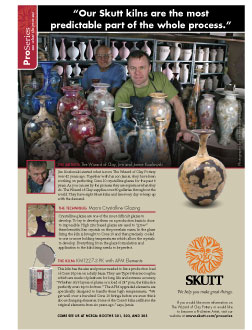
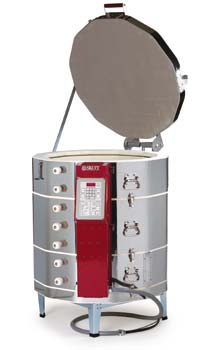
THE KILN: 8 Skutt KM1227-3PK kilns with APM elements and S type thermocouples. Jamie uses 8 Skutt KM1227-3PK kilns with APM elements and S type thermocouples. The PK line of kilns provides the extra power required to bring a large kiln to cone 10 temperatures on a consistent basis. They do draw more amperage then a standard kiln but due their ability to efficiently reach temperatures they often use less wattage and therefore are less expensive to fire. APM elements are made from a special type of element wire produced by Kanthal. They actually take regular element wire, grind it up, and sinter it back together. This gives it a cell structure that resembles a brick wall as opposed to a stack of ball bearings. This cell structure prevents the element coils from getting limp and laying down on themselves at high temperatures. Jamie gets up to 130 cone 10 crystal firings on a set of elements,which is about 3 to 4 times the life of a standard element under those extreme conditions. Some of the kilns he fires only to cone 5 and over a 6 year period he has never had to change elements on some of them. If you are only firing to bisque temperatures,APM elements last about the same amount of time as standard elements; therefore,due to their high cost are not recommended. When it is time to change elements Jamie has found that it is not necessary to replace them all at once. Sometimes only 1 or two need replacing. While Zone Control is an available option for this model, Jamie has found that the elements are so well balanced that he gets perfectly even temperature on every shelf without it. Jamie uses S type thermocouples, which are made out of Platinum. They do not oxidize like standard type K thermocouples. This means they will last and remain accurate virtually forever. They are expensive to replace so you want to be very careful not to break them when loading your kiln. Jamie uses a specific mix of cone 10 porcelain that he has found lays the foundation for growing great crystals. Since the clay can interact with glaze it is important to pick a porcelain supply that is consistent. That way when you make subtle changes to your firing program and and/or glaze formulation you will know the clay has remained a constant. Porcelain clay bodies havelessaluminathan stoneware bodies, and are preferred for crystalline glazing. Aluminaacts as a stabilizer in glazes, and can restrict crystal growth. Crystalline glazes can actually leach alumina out of a clay body at hightemperatures, andtherefore the results are not as spectacular on a stoneware clay body as compared to porcelain. The shape of your pot is not terribly important for growing crystals. It is important to note thatcrystallineglazes are very runny, due to the lack of alumina in the glaze.You need to develop a method of keeping the glaze from running off the pot onto your kiln shelf. Jamie throws a cylinder with a catch basincustom fittoeach piece. He bisque fires the pieces to cone 03 using the ConeFire program atslow speed. This gives the porcelain enough time to out - gas and eliminates blebbing in the clay body later at high temperatures. Hethen gluesthe catch basin to the bottom of the vessel using a 50/50 mixture of Elmer’s white glue and Alumina Hydrate.All of his glazes are custom blended in small 1000 gram batches with slight variations in materials to suit the needs of particular shaped vases, and also to compensate for additions of metallic oxides that canadd additional fluxing properties to the glaze.After the glaze firing he can easily separate the cylinder from the finished pieceby gently heating the foot of the vase where it meets the pedestal/catch pan with a torch. Then a tap of a hammer knocks it off clean.The foot is then ground clean and smooth THE GLAZE: 50% Frit (Ferro 3110, Fusion Fit 644, and Fusion Fit 413 are good ones forcrystallineglazes) This is about a cone 9 glaze and is a good place to start with any new recipe, or if you're just starting to try crystalline glazing. A cone 10 glaze would have less frit, and more silica. The percentage of zinc is important: more will give you more crystals, but if you reduce it too much you may end up with no crystals at all. Jamie has his additions of zinc honed from 1/2% to 2% for different color glazes,shapes and sizes of his vases, plates, and bowls,and for the exact temperature the pieces will be fired to. From here you add ingredients that will affect the color, the size, shape and quantity of crystals, and the viscosity of the glaze. Oxides andcarbonates are added to affect the color of the glaze. Below is list of common ones and the colors they produce: Nickel Oxide –Teal crystals on ayellow to amber background. 3% is plenty. For example, a blue crystal on a tan background can be achieved by adding 6 to 10% titanium to a glaze with 1-2% iron oxide and .25 to .75% cobalt oxide. Without the titanium, the cobalt would take over and the piece would be just all blue. Titanium can help to '"seed" a crystal glaze, causing more crystals to grow and also affecting the fullness and shape of the crystals. The glaze can be dipped, brushed or sprayed on. Jamie prefers to spray hisglazebecause it gives him the best control over uniformity and the thickness of the application.Some glazes need to be applied thinner, some thicker, depending again on the formulation of the glaze, and how much heat-work will be used in firing the piece. THE FIRING: This is where all of the magic happens. Havingan accurate consistent firing kilnwith power to spareis crucial to getting the repeatable resultsto achievethese world classcrystalline glazes on a production basis. Jamie designs his own custom Ramp and Hold Program for theglazefiring.The programbelow is an example of a range in which one can be successful with crystalline glazes. Jamie fires within these extremes. In the first segment Jamie fires as fast as he can because time is money when you are in production and his ware can handle it. When the kiln reaches around 2100 F his glazes begin to flow. That is the point where he slows the rate of climb. This givesall the glazes in the kilna chanceto melt and flow evenly over the entire piece. He always puts a Cone 10witnessCone next to a peep hole so he can look through and see exactly when the tip bends over and touches the shelf. At this point, if the kiln hasn’t already gone to the next ramp, he will use the Skip Step feature to advance the program. Step 3 cools the kiln down to a point where the glaze gets stiff again and the crystals can grow. Step 4 then cools the kiln very slowly through this period where the crystals like to grow. Other programs may use hold time and specific stepped temperatures to achieve similar results. The kiln may even be programmed to rise in temperature again in this temperature range to achieve certain affects likehalos that look a lot likethe growth ringsin a tree. There are many different programs and temperaturesettings that will work for crystalline glazes. It is something that takes time and experimentation to learn. Everything must be considered -from the porcelain body, what temperature it will be fired to, and all of the raw materials in the glaze. The effects of additional oxidesto that glaze must be considered as well,along with hold temperatures that will be used for the crystal formations. Contact Email: [email protected]  |
||||||||||||||||||||||||||||